Where does the Siberian tiger live?
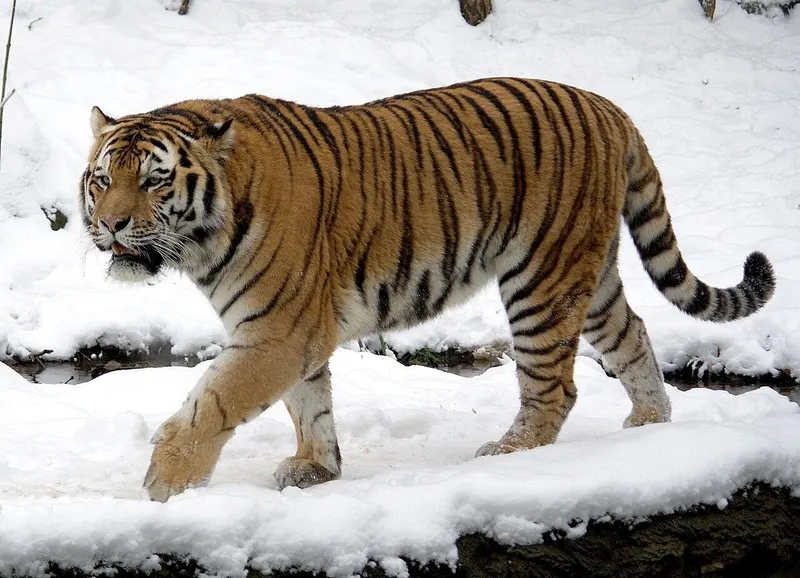
The Siberian tiger, or Amur tiger, is the largest subspecies of tiger. It lives in the north of the Far East, mainly in the Russian Far East, in the Sikhote-Alin mountain region, and in north-eastern China. It once ranged over most of the Korean Peninsula, but was wiped out there under Japanese rule, between 1910 and 1945. Since 2017, a reintroduction programme has been under way in Kazakhstan.
What does the Siberian tiger eat?
It is the third-largest land predator, behind the Kodiak bear and the polar bear. It feeds on wild animals, its "prey species", whose hunting by humans also threatens it. It has a bigger, heavier body than the Bengal tiger and broader paws, standing 100 to 120 cm at the shoulder. Its claws are about 10 cm long. It needs vast territories: 1,380 km² on average.
Is the Siberian tiger endangered?
Yes: it is Endangered. In the middle of the 20th century only about twenty wild individuals were left, but strong protection measures in Russia let it recover. A 2015 census counted 562 tigers in Russia. It remains threatened by habitat destruction, disease and poaching, since its fur is worth a great deal in Asia.
All 71 threatened animals ›