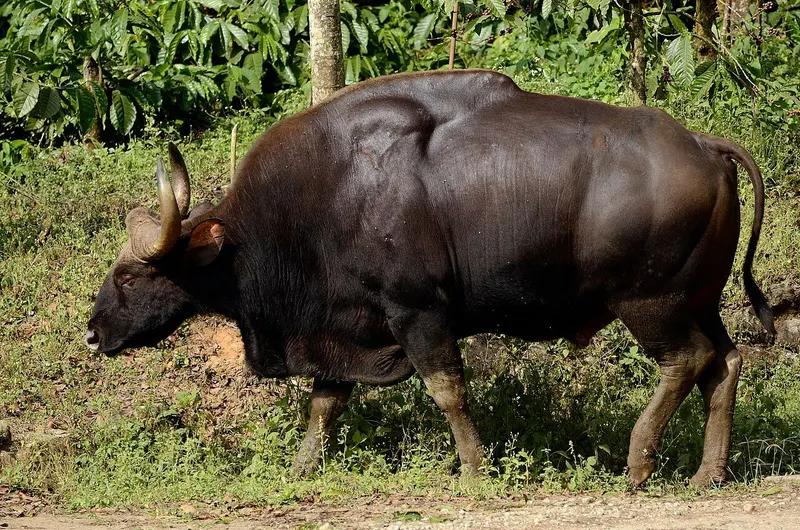
Where does the gaur live?
The gaur lives on the Indian subcontinent and in South-East Asia. It historically occurred throughout mainland South and South-East Asia, from Nepal to China, but today its range is seriously fragmented. It is largely confined to evergreen, semi-evergreen and moist deciduous forests, but also inhabits deciduous forest at the periphery. Its habitat is characterised by large, relatively undisturbed forest tracts, hilly terrain below 1,500 to 1,800 m, water and an abundance of forage.
What does the gaur eat?
The gaur finds its food in the grasses, bamboo, shrubs and trees of its habitat. It is the largest of the wild cattle, and the largest of the bovids. The gayal or mithun, a domesticated form, originated partly from the wild gaur, and is most common in the border regions of north-east India, Bangladesh, Myanmar and Yunnan.
Is the gaur endangered?
Yes: the IUCN has listed it as Vulnerable since 1986. The global population was estimated at a maximum of 21,000 mature individuals in 2016, most of them in India. In Laos and Thailand it is severely threatened by poaching for the commercial trade in meat and trophies. In Nepal, the gaur population was estimated at 250 to 350 in the mid-1990s.
All 71 threatened animals ›