Where does the vicuña live?
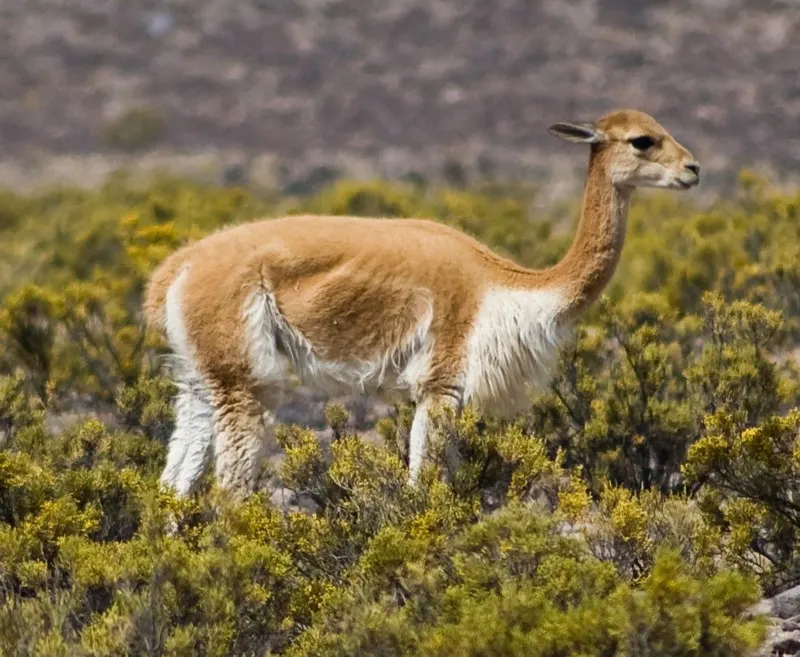
The vicuña is a wild South American camelid that lives in the high alpine areas of the Andes, at altitudes of 3,200 to 4,800 m. It feeds in the daytime on the grassy plains of the Andes but spends the nights on the slopes. It is a relative of the llama, the domesticated descendant of the guanaco, and is believed to be the ancestor of the domesticated alpaca. It is the national animal of Peru and appears on its coat of arms.
What does the vicuña eat?
The vicuña's diet consists mainly of low grasses that grow in clumps on the ground, in areas where only nutrient-poor, tough grasses grow. Its long, woolly coat is tawny brown on the back, while the hair on the throat and chest is white and quite long. It produces small amounts of extremely fine wool, which is very expensive because the animal has to be caught from the wild to be fleeced and can only be shorn every three years. The Inca valued it highly, and only royalty was allowed to wear it.
Is the vicuña endangered?
No: the IUCN lists it as Least Concern. Yet it was heavily hunted: only about 6,000 animals were left when it was declared endangered in 1974. Today the population has recovered to about 350,000, but conservation organizations still call for active programs against poaching and habitat loss.