Where does the chital live?
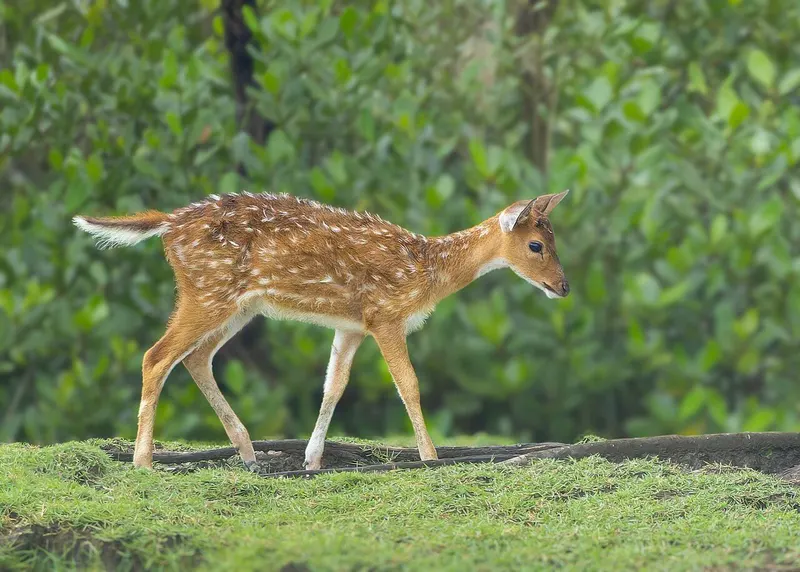
The chital, or axis deer, is a deer native to the Indian subcontinent: it lives naturally in the wooded regions of India, Sri Lanka, Bangladesh, Nepal and Bhutan. It lives in deciduous and semi-evergreen forests and open grasslands. It has been introduced to central Europe, the former Yugoslavia, Australia, Brazil, Argentina, Uruguay, Texas and Hawaii. Its Hindi name means "with spots".
What does the chital eat?
The chital mainly feeds on grasses throughout the year, and also browses foliage, herbs and fruits, especially from October to January. It visits water holes nearly twice daily. It forms matriarchal herds of an adult female and her offspring, and aggregations of up to 100 individuals have been observed. When alarmed, it flees in groups. Its predators include tigers, leopards, Indian pythons and dholes.
Is the chital endangered?
No: the IUCN lists it as Least Concern, due to its wide range and large populations. Hunting for meat nonetheless causes declines and local extinctions, and it competes with livestock. Its upper parts are golden to rufous, covered in white spots, and the male's three-pronged antlers are nearly 1 m long.