Where does the Verreaux's sifaka live?
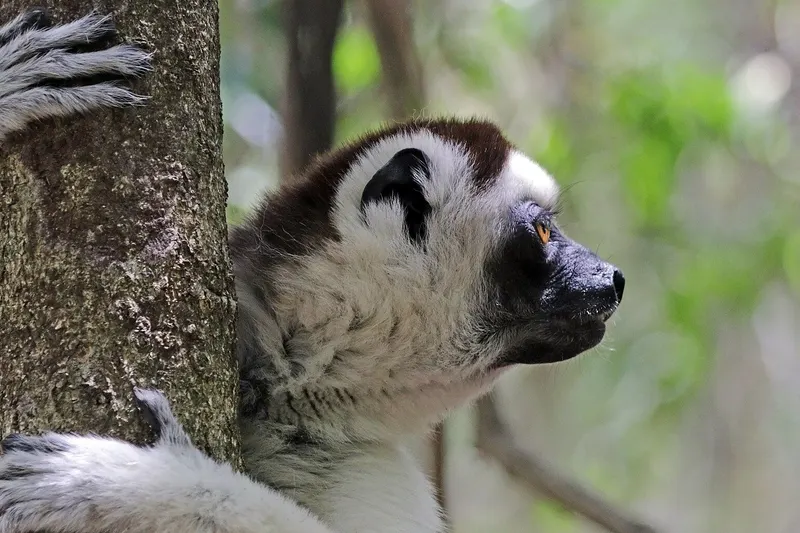
Verreaux's sifaka, or the white sifaka, is a medium-sized lemur, endemic to south-western Madagascar. It lives in a variety of habitats, from rainforest to the dry deciduous forests of western Madagascar and the spiny thickets of the south. Its body is adapted to an arboreal existence, in which the major form of locomotion is vertical leaping. On the ground its only means of locomotion is a "dancing" form of hopping.
What does the Verreaux's sifaka eat?
It is primarily folivorous: it eats leaves, fruit, bark and flowers. It forages for food with its troop, primarily in the morning and late afternoon, so it can rest during the hottest part of the day. It lives in smallish groups of about 2 to 13 animals. Its fur is thick and silky, generally white with brown on the sides, top of the head and arms.
Is the Verreaux's sifaka endangered?
Yes: the IUCN lists it as Critically Endangered, despite a wide distribution. It is probably the smallest of its genus: it measures 40 to 48 cm and weighs 3.0 to 3.5 kg, with a tail longer than the body, up to 60 cm.
All 71 threatened animals ›