Where does the proboscis monkey live?
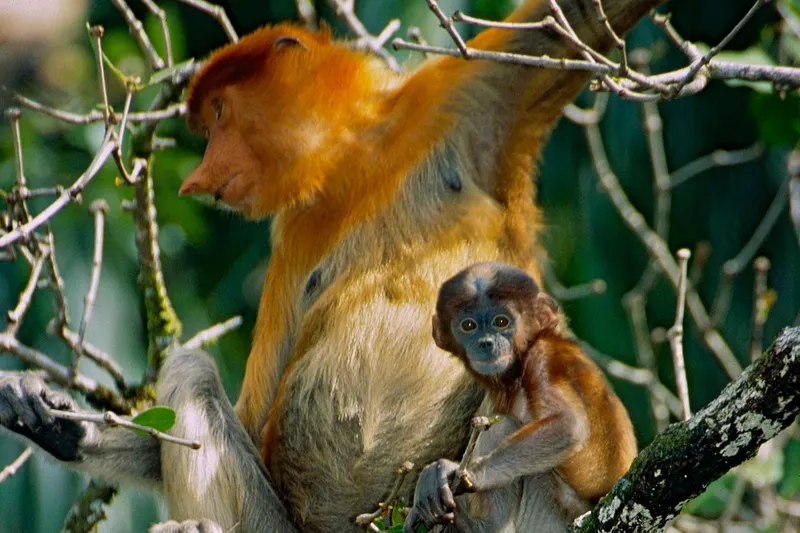
The proboscis monkey is an arboreal Old World monkey with an unusually large nose, endemic to the Southeast Asian island of Borneo. It is found mostly in mangrove forests and on the coastal areas of the island. It co-exists with the Bornean orangutan and monkeys such as the silvery lutung. The largest remaining populations are in Kalimantan, with far fewer in Sarawak, Brunei and Sabah.
What does the proboscis monkey eat?
It eats primarily fruit and leaves, and to a lesser extent flowers, seeds and insects: at least 55 plant species. One-male groups consist of 3 to 19 individuals. It can swim up to 20 m underwater, and swims across rivers. One theory suggests the large nose may be due to sexual selection by females, who prefer louder vocalisations, with the size of the nose increasing the volume of the call.
Is the proboscis monkey endangered?
Yes: the IUCN lists it as Endangered. Its population declined by over 50% in 36 to 40 years, due to habitat loss from logging and oil palm plantations, and hunting, as it is treated as a delicacy and used in traditional Chinese medicine. Males have a head-body length of 66 to 76.2 cm and weigh 16 to 22.5 kg, females 53.3 to 62 cm and 7 to 12 kg.
All 71 threatened animals ›