Where does the greater kudu live?
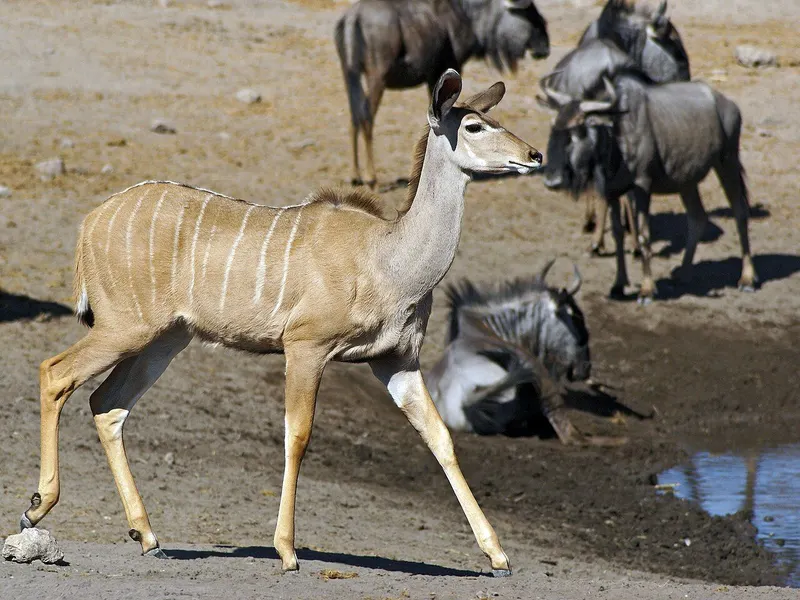
The greater kudu is a large woodland antelope, found throughout eastern and southern Africa, from Ethiopia, Tanzania, Eritrea and Kenya in the north to Zambia, Angola, Namibia, Botswana, Zimbabwe and South Africa. It lives in mixed scrub woodlands, mopane bush and acacia, in lowlands, hills and mountains, and avoids open plains. Despite such a widespread range, it is sparsely populated in most areas, due to declining habitat, deforestation and poaching.
What does the greater kudu eat?
Its diet consists of leaves, grass, shoots and occasionally tubers, roots and fruit: it is especially fond of oranges and tangerines. Females form herds of 6 to 10 with offspring, sometimes up to 20. Males are typically solitary or in small bachelor groups, joining the females during the mating season. Its predators include lions, spotted hyenas and African wild dogs.
Is the greater kudu endangered?
No: the IUCN lists it as Least Concern. Males have horns with two and a half twists, averaging 120 cm long when straightened, with a record of 187.64 cm. Bulls stand up to 1.6 m at the shoulder and weigh 190 to 270 kg, cows 120 to 210 kg.