Where does the bighorn sheep live?
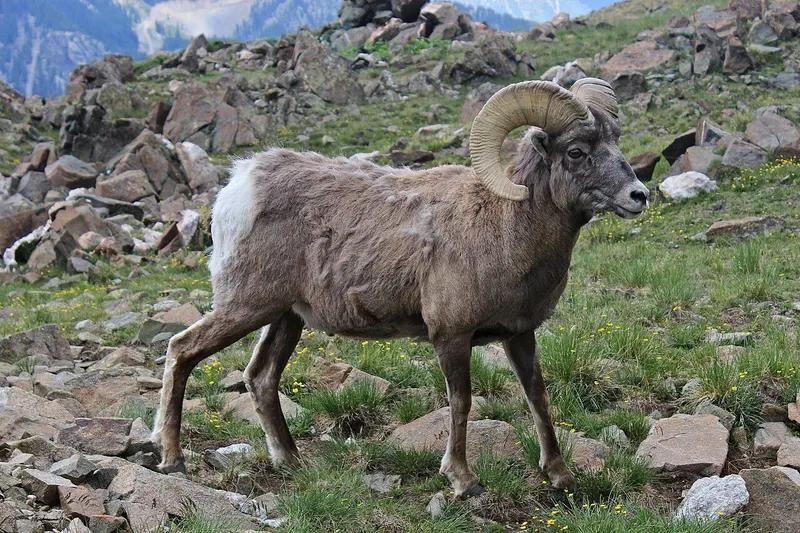
The bighorn sheep lives mainly in south-western Canada, the western United States and Baja California in Mexico. It is named for the large, curved horns carried by the rams: a pair may weigh up to 14 kg, as much as all the bones in the male's body. Ewes also have horns, but they are shorter and straighter. Sheep originally crossed to North America over the Bering Land Bridge from Siberia.
What does the bighorn sheep eat?
Before the rutting season, a dominance hierarchy is established among the rams and determines access to ewes for mating. Horn clashes take place during this pre-rut if two sheep have horns of identical size, though this can occasionally happen throughout the year. In temperate climates, the peak of the rut is in November, with one lamb, rarely two, born in May. Males weigh 58 to 143 kg, females 34 to 91 kg.
Is the bighorn sheep endangered?
No: the IUCN lists it as Least Concern. But the population, which peaked in the millions, crashed to several thousand by 1900, due to diseases introduced through European livestock and overhunting. Recent genetic testing indicates three distinct subspecies, one of which, the Sierra Nevada bighorn, is endangered.